Welcome to the Future of Physical Education!

FeedForward: Elevating PE Performance

Beyond Grades, Beyond Words.

Ever felt like your feedback to students just disappears into thin air? You're not alone. FeedForward is your ultimate instructional companion designed to transform every drill into a moment of real learning.

Why Feedback Matters?

Real-Time Corrections

Adjust movements instantly with oral guidance during gameplay or exercise.

Long-Term Reflection

Use written notes to build lasting skills and track growth over several sessions.

Increased Motivation

Clear, supportive feedback builds confidence and a growth mindset in every learner.

Understanding Feedback in PE

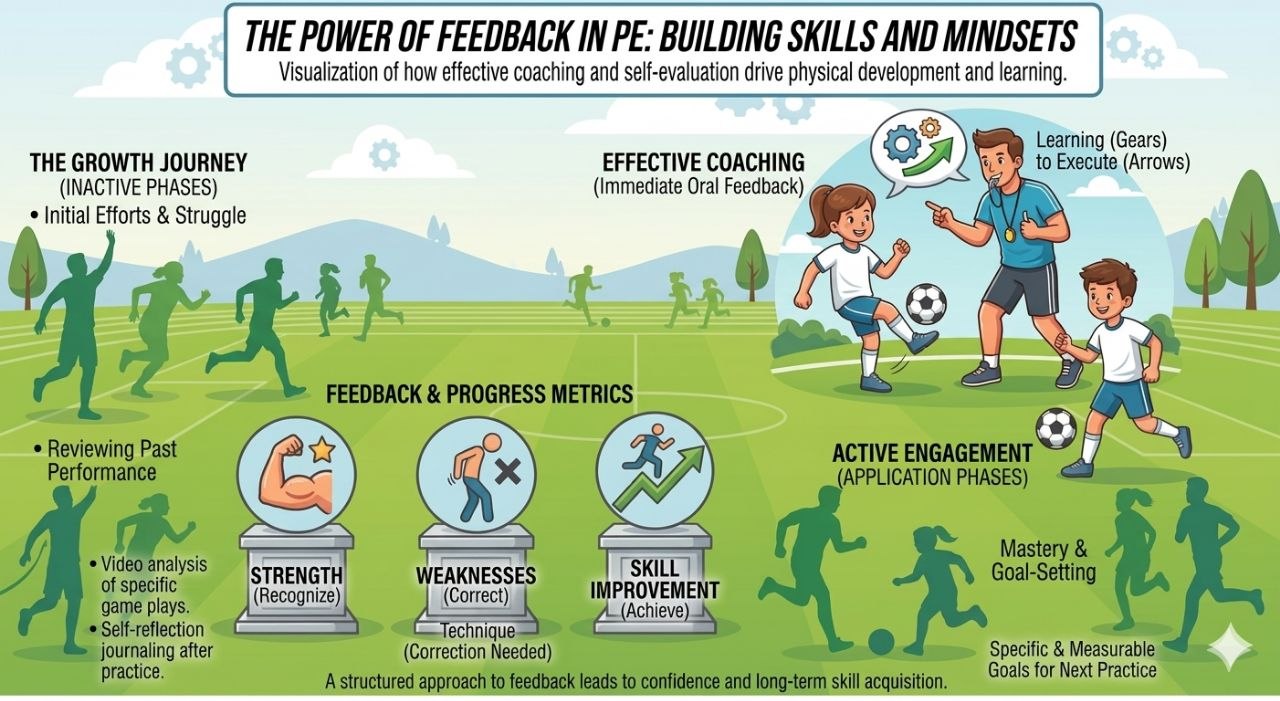
Feedback is defined as information provided to learners regarding their performance, behavior, or understanding, with the purpose of improving learning outcomes.

In Physical Education, feedback is particularly vital because learning is performance-based. It requires constant monitoring to ensure that skills are executed with precision and safety.

The Three Essential Questions:

Effective feedback, according to Hattie & Clarke (2019), answers three essential questions:

  • 1
    Where am I going?
    Establishing clear learning goals.
  • 2
    How am I going?
    Checking progress against those goals.
  • 3
    Where to next?
    Identifying steps for further improvement.

Primary Feedback Types

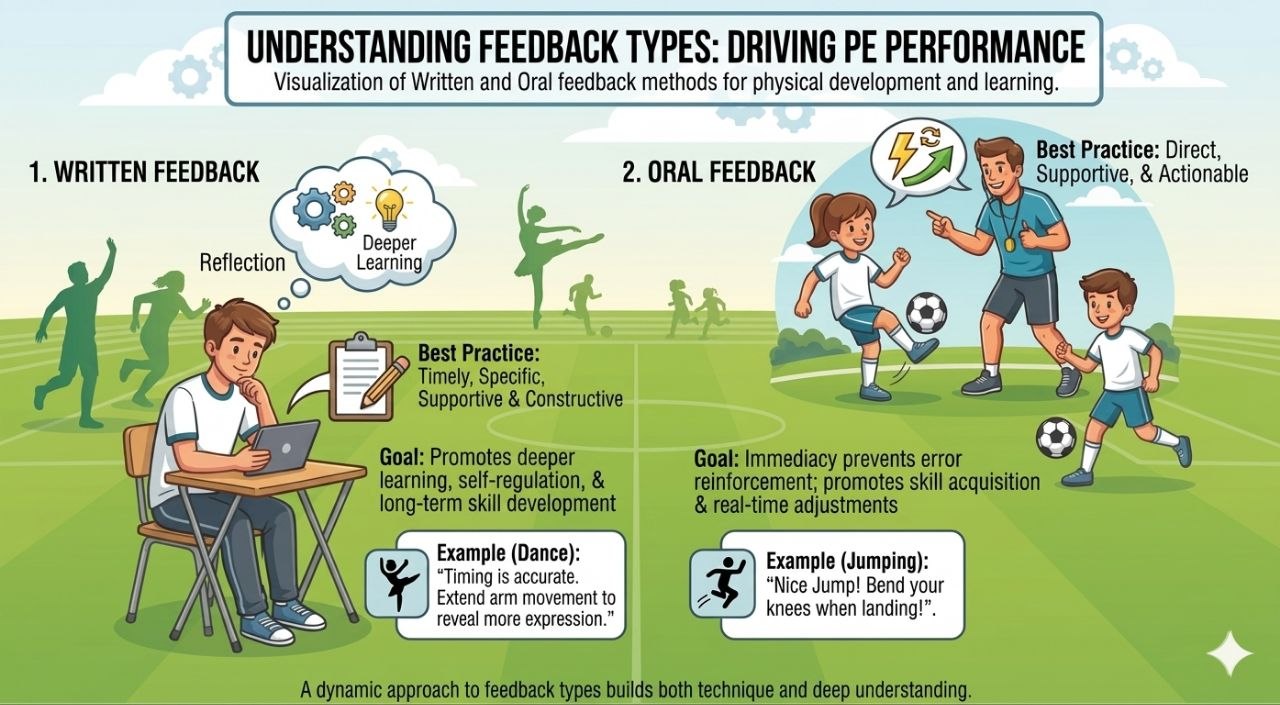
In the Physical Education environment, the delivery method of feedback is just as important as the message itself. Depending on the complexity of the skill and the timing of the lesson, teachers generally utilize two primary forms of feedback: Written and Oral.

While Oral Feedback is the "bread and butter" of a fast-paced gym environment, Written Feedback provides a permanent record that students can revisit during self-reflection periods. Effective PE programs strike a balance between these two:

  • 1
    Use Oral Feedback
    for safety corrections, quick technical tweaks, and maintain high energy during gameplay.
  • 2
    Use Written Feedback
    for complex rubrics, dance choreography evaluations, or personal fitness goal-tracking.

Key Takeaways: Regardless of the type, the best feedback in PE is always actionable. It doesn't just tell a student what they did wrong; it shows them exactly how to get it right.

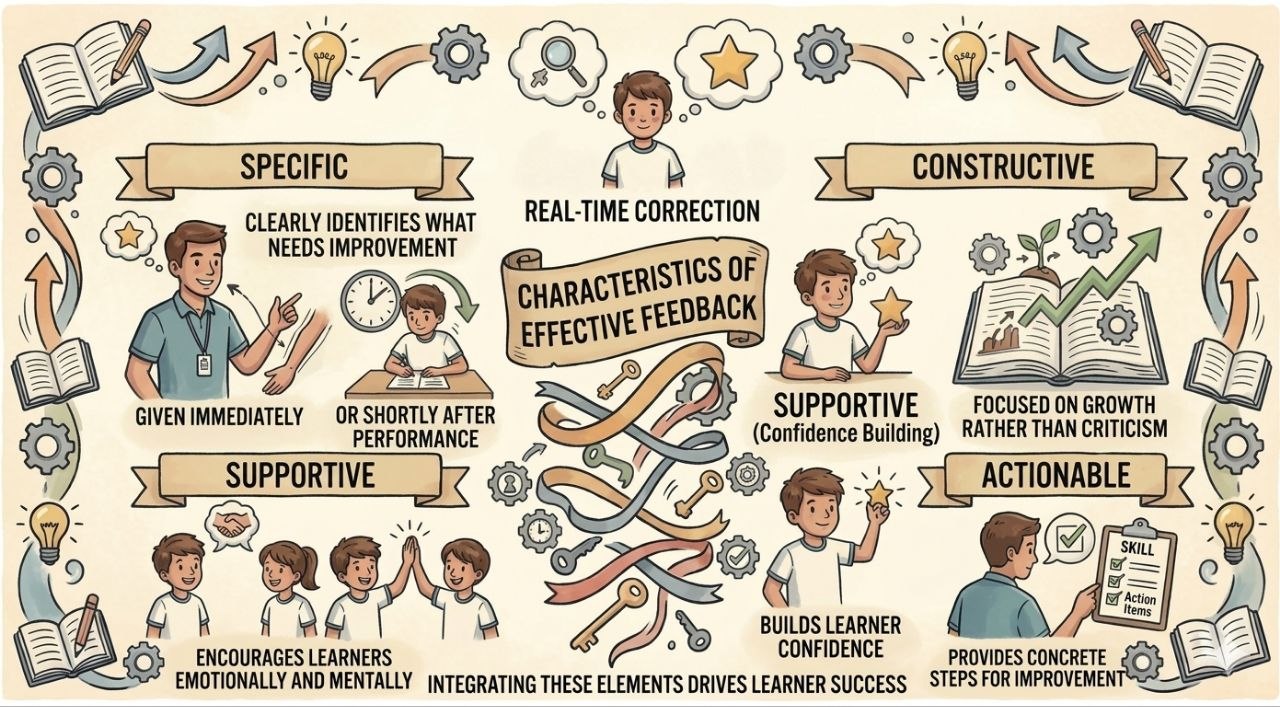
Characteristics of Effective Feedback

Feedback is more than just a comment; it is the most powerful tool a physical educator has to bridge the gap between a student's current ability and their potential. Because PE is performance-based, continuous monitoring and real-time correction are essential for student success.

The following guide integrates research-based frameworks—including Hattie & Clarke’s essential questions and Brookhart’s effectiveness standards—to provide a complete roadmap for high-impact feedback.

To maintain the Supportive and Constructive traits identified by Brookhart (2017), many educators use the "Sandwich" method. This ensures that technical correction is framed within a positive learning environment

  • 1
    The Positive Opener:
    Start with a specific aspect of the performance done correctly (e.g., "Your foot placement is perfect!").
  • 2
    The Technical Tweak:
    Provide the actionable correction (e.g., "Now, try to follow through with your arm toward the target.")
  • 3
    The Encouraging Closer:
    Connect the correction to the student's potential (e.g., "Keep that up, your accuracy is improving every time!").

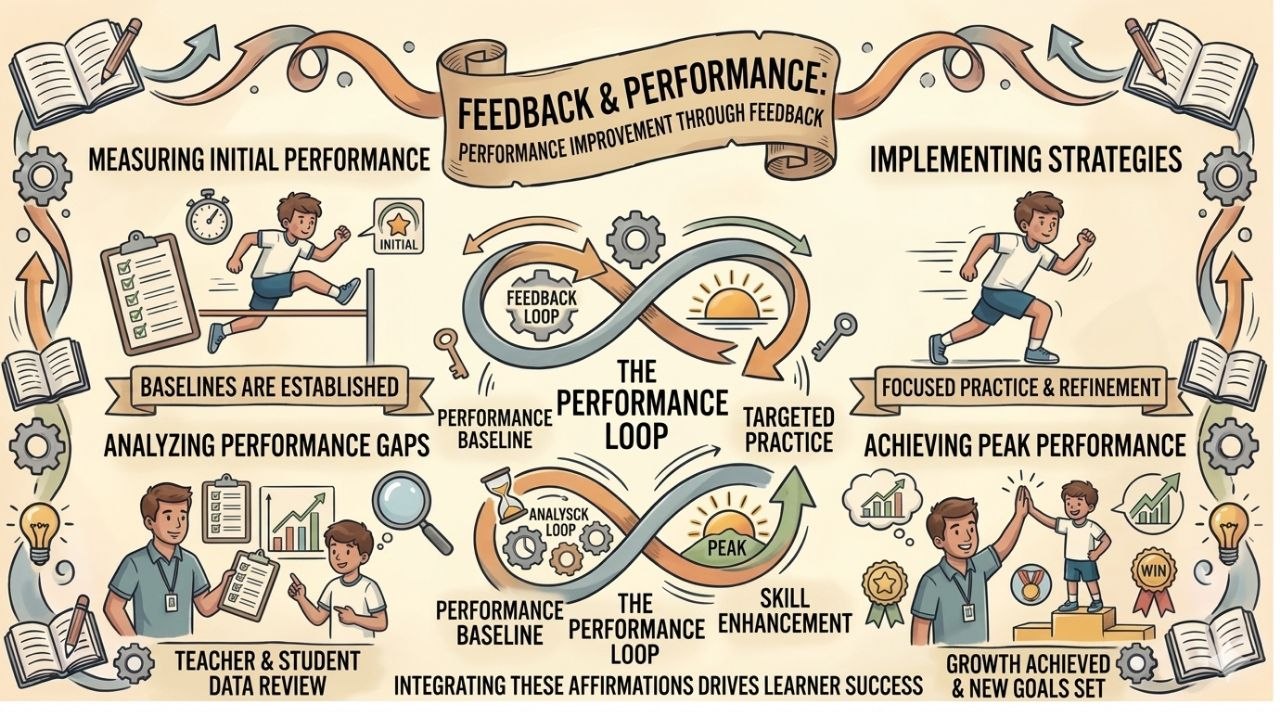
Impact of Feedback

Feedback in Physical Education is more than just a corrective tool; it is a catalyst for student transformation. By providing clear, intentional information, educators can simultaneously address the cognitive and emotional needs of the learner. When feedback is delivered effectively, it creates a ripple effect that touches two vital areas of development: Motivation and Performance. The following visual guide outlines how high-impact feedback fosters a growth mindset while sharpening the technical skills necessary for athletic and physical success.

Effective feedback is the most powerful bridge a physical educator can build. It transforms a simple gym session into a dynamic learning environment where students feel seen, supported, and challenged. By balancing Motivation to build confidence and Performance to build skill, you provide students with more than just instructions—you provide them with the roadmap to their own potential.

Addressing Challenges

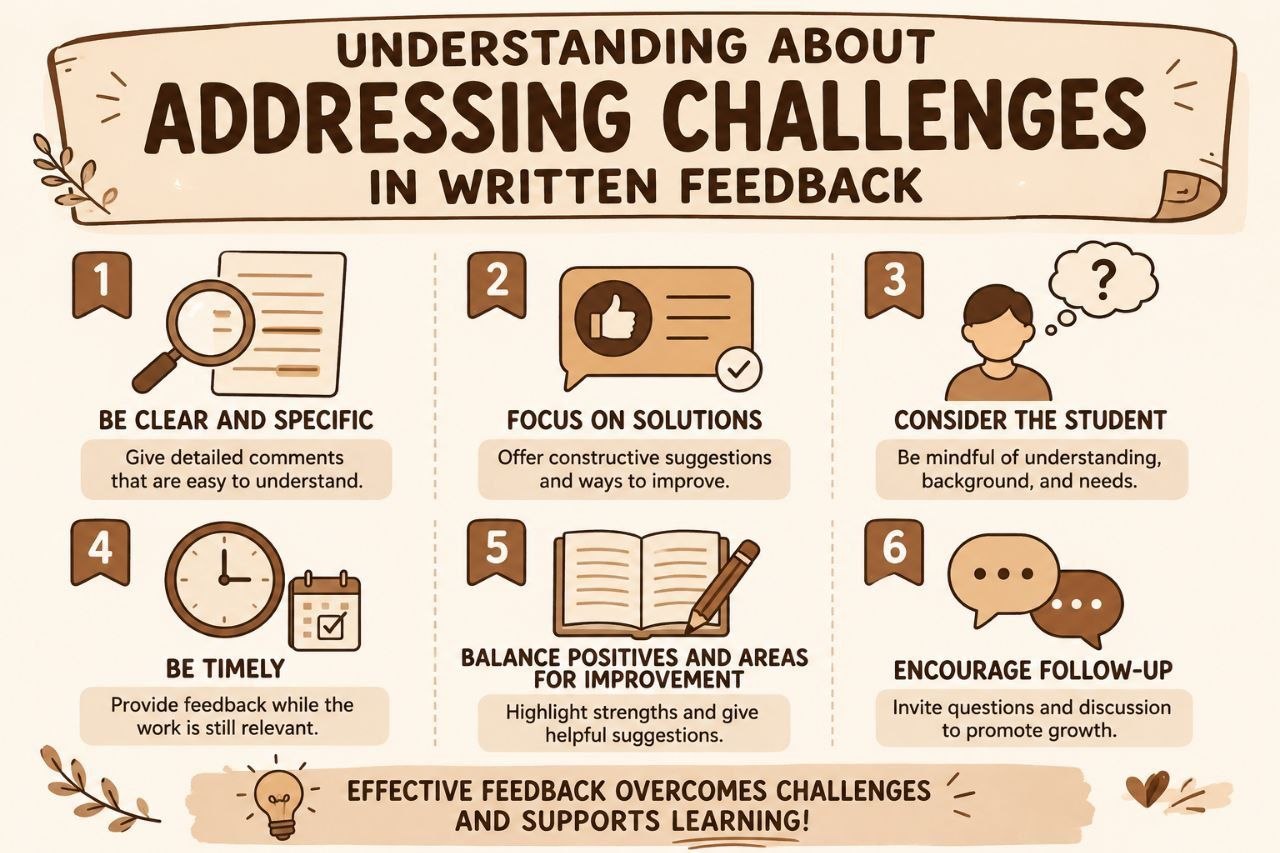
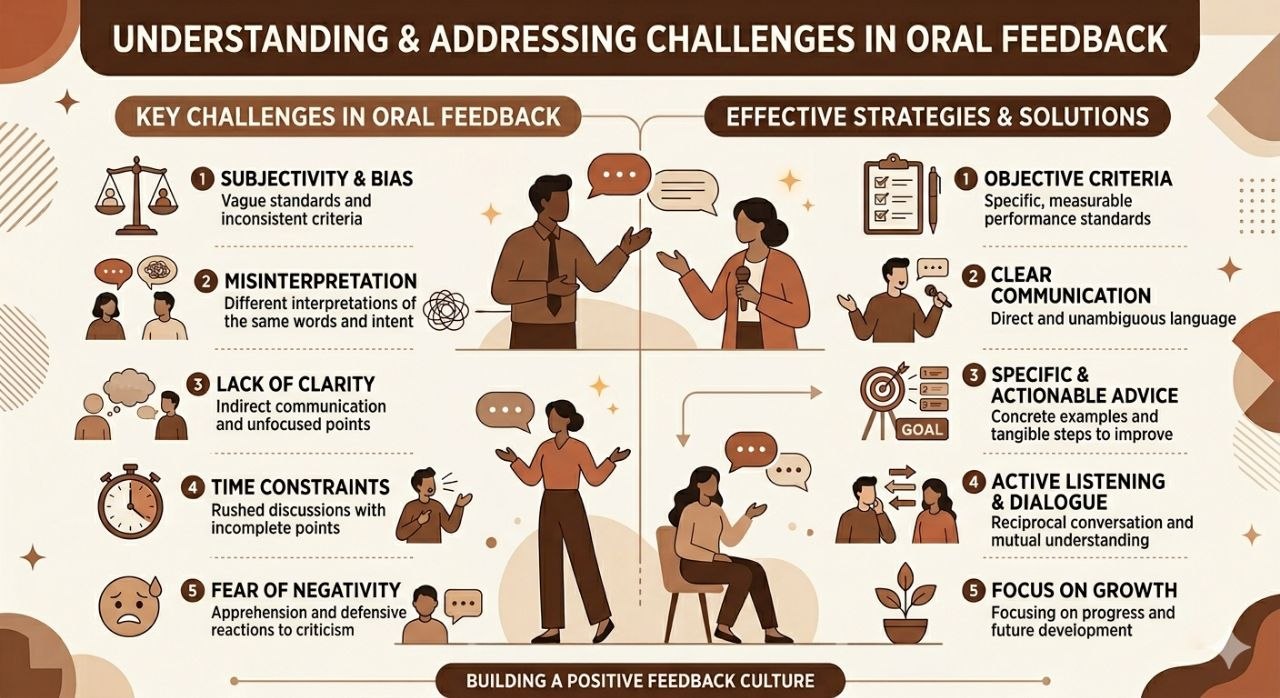
Providing effective feedback can be difficult due to several factors: Unclear Communication: Use simple and direct language to avoid confusing students. Delayed Responses: Provide feedback immediately during or after activities so students remember the specific actions to correct. Student Anxiety: Create a safe and encouraging environment to make students more receptive to constructive criticism.

In the fast-paced environment of Physical Education, feedback is the most powerful bridge between a student’s current ability and their future potential. While challenges like communication barriers or student anxiety exist, they are not insurmountable. By remaining intentional, immediate, and encouraging, educators can transform every correction into a moment of connection.

Remember: The goal of feedback is not just to correct a movement, but to build the athlete's confidence to try again.

To maintain the Supportive and Constructive traits identified by Brookhart (2017), many educators use the "Sandwich" method. This ensures that technical correction is framed within a positive learning environment

  • 1
    The Positive Opener:
    Start with a specific aspect of the performance done correctly (e.g., "Your foot placement is perfect!").
  • 2
    The Technical Tweak:
    Provide the actionable correction (e.g., "Now, try to follow through with your arm toward the target.")
  • 3
    The Encouraging Closer:
    Connect the correction to the student's potential (e.g., "Keep that up, your accuracy is improving every time!").

Assessment and Implementation

The quality of feedback is vital, its success ultimately depends on how it is managed within the classroom. To move from spontaneous comments to an organized system of growth, educators must integrate feedback into the formal assessment structure. This requires the use of objective tools like Rubrics and a disciplined Implementation Plan. By treating feedback as a planned phase of the lesson—rather than an afterthought—physical educators can ensure that every student receives a fair, consistent, and actionable roadmap toward mastering physical skills.

Mastering the implementation of feedback is not a one-time event; it is an ongoing cycle of Planning, Action, and Reflection. By utilizing rubrics, you remove the guesswork for students, allowing them to take ownership of their own learning journey. As you apply these three key steps in your curriculum, you will find that your feedback becomes more than just a reaction to a mistake—it becomes a strategic intervention that drives long-term motor skill development and student confidence.

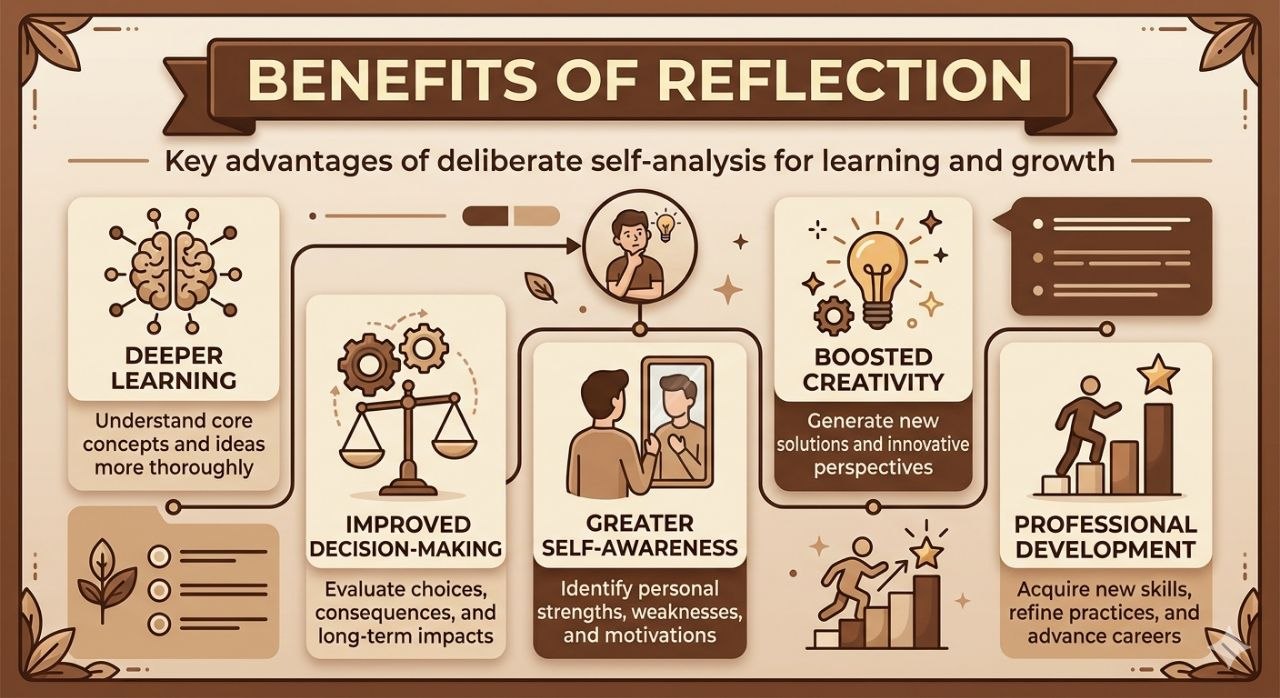
Students Reflection

Feedback is a two-way street. While the teacher provides the initial guidance, the most profound growth occurs when the student pauses to internalize that information. Student reflection is the key to shifting from passive participation to active, self-regulated learning. By encouraging students to think critically about their own performance, we help them develop a "growth mindset" where errors are seen as data points for improvement rather than signs of failure.

When students consistently ask themselves these reflection questions, they stop relying solely on the teacher for "the answers" and start finding them within their own movements. This process of internalizing feedback is what allows a student to make adjustments mid-game or mid-routine without being told. Ultimately, our goal is to graduate students who are not just physically active, but physically literate—capable of assessing their own progress and setting their own path toward mastery.

Glossary

Actionable: Information or data that is clear and specific enough to be acted upon or put into practice.
Assessment: The systematic process of documenting and using empirical data on knowledge, skill, attitudes, and beliefs to refine programs and improve student learning.
C
Constructive: A method of providing feedback or criticism that is useful and intended to help or improve something.
E
Effective: Successful in producing a desired or intended result.
F
Feedback: Information about reactions to a product, a person's performance of a task, etc. used as a basis for improvement.
G
Growth Mindset: The belief that abilities and intelligence can be developed through dedication and hard work.
I
Implementation: The process of putting a decision or plan into effect; execution.
M
Motivation: The reason or reasons one has for acting or behaving in a particular way; the general desire or willingness of someone to do something. Motor Skill: A function, which involves the precise movement of muscles with the intent to perform a specific act.
O
Oral: Spoken rather than written; relating to the mouth.
P
Performance: The action or process of carrying out or accomplishing an action, task, or function.
R
Reflection: Serious thought or consideration; the return of light, heat, or sound without absorbing it.
Rubric: A scoring guide used to evaluate the quality of a particular type of student work.
S
Self-Regulated: A process of taking control of and evaluating one's own learning and behavior.
Specific: Clearly defined or identified; precise.
Supportive: Providing encouragement or emotional help. T
Timely: Done or occurring at a favorable or useful time.
W
Written: Expressed in writing rather than in speech.

References

  • 1
    Brookhart, S. M. (2017). How to give effective feedback to your students (2nd ed.). ASCD.
    (Source for the characteristics of effective feedback and the importance of supportive/constructive tones.)
  • 2
    Hattie, J., & Clarke, S. (2019). Visible learning: Feedback. Routledge.)
    (Source for the "Three Essential Questions": Where am I going? How am I doing? Where to next?)
  • 3
    Hattie, J., & Timperley, H. (2007). The power of feedback. Review of Educational Research, 77(1), 81–112.
    (The foundational research paper that established feedback as one of the most powerful influences on student achievement.)
  • 4
    Wiggins, G. (2012). Seven keys to effective feedback. Educational Leadership, 70(1), 10–16.
    (Supporting reference for actionable and timely feedback strategies in performance-based learning like PE.)
  • 5
    Magill, R. A., & Anderson, D. I. (2021). Motor learning and control: Concepts and applications (12th ed.). McGraw-Hill Education.
    (The definitive source on 'Knowledge of Results' and 'Knowledge of Performance' feedback in sports.)
  • 6
    • Shute, V. J. (2008). Focus on formative feedback. Review of Educational Research, 78(1), 153–189.
    (A critical study on how feedback helps students manage their own learning and reduces cognitive load)
  • 7
    • Whitehead, M. (2010). Physical literacy: Throughout the lifecourse. Routledge.
    (Provides the context for your 'Outro' regarding the goal of creating physically literate individuals)
  • 8
    • Wiliam, D. (2018). Embedded formative assessment (2nd ed.). Solution Tree Press.
    (Excellent for the 'Assessment and Implementation' section, focusing on how feedback functions as an assessment tool.)
  • 9
    • Schmidt, R. A., & Lee, T. D. (2019). Motor learning and performance: From principles to application. Human Kinetics.
    (Explains the 'Addressing Challenges' section, specifically why immediate feedback is vital for correcting physical movements.)